

Did the Universe Just Send Us a Message?
Why the First Image of Quantum Entanglement Might Not Be a Coincidence and What It Means for You

It was a discovery that left physicists and philosophers alike in awe. For the first time, researchers were able to capture the joint state of two entangled photons in real time using a method called biphoton digital holography… a way of encoding and reconstructing images using the correlations between entangled particles. And what did the image they chose to encode and then reconstruct look like? A striking resemblance to the ancient yin-yang symbol… a black and white interplay, eternally connected.
A coincidence? Materialists would say so. But is it possible there’s more to this story… something ancient mystics, Taoist sages, and modern meditators have always known?
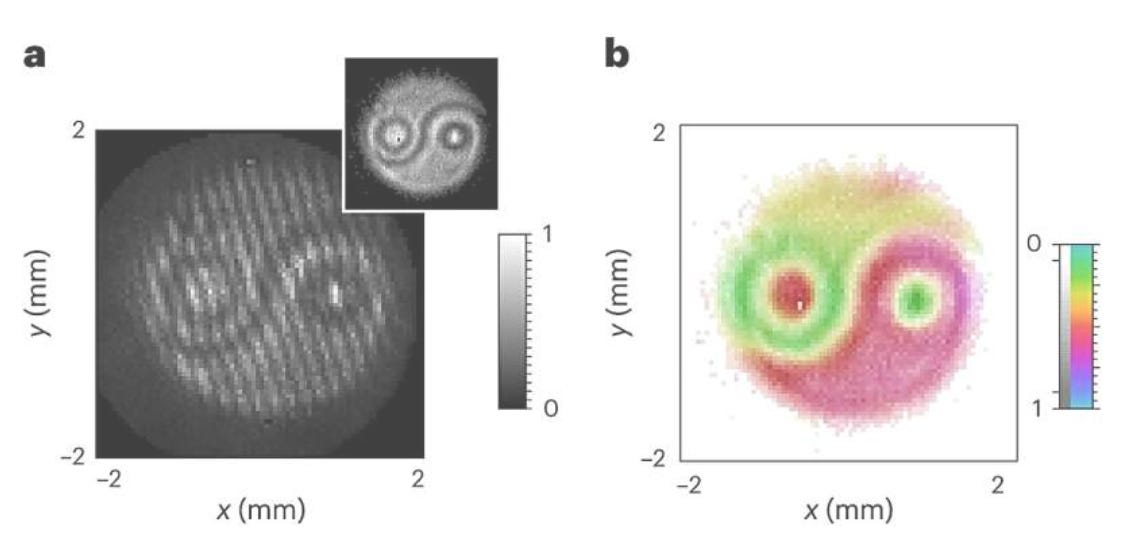
Actual image of entangled photons source: Danilo Zia et al, Interferometric imaging of amplitude and phase of spatial biphoton states, Nature Photonics (2023). DOI: 10.1038/s41566-023-01272-3 Journal information: Nature Photonics
Entanglement 101: The Science of Interconnection
Before we explore this synchronicity, let’s take a brief look at what entanglement is. Imagine two particles created together. Even if you separate them by vast distances, their states remain tied. Measure one particle, and the other reacts instantaneously. Einstein famously called this “spooky action at a distance,” a description that still holds weight today.
This discovery shattered classical notions of a separable, predictable universe. Entanglement reveals a deeper, hidden unity—two entities acting as one. Doesn’t this echo something deeply familiar, something encoded in the yin-yang itself?
The Yin-Yang: More Than Just Duality
The yin-yang is often misunderstood as merely a representation of opposites: light and dark, male and female, good and bad. But the truth is far more profound. In Taoist philosophy, the yin-yang embodies unity and interdependence.
Consider the two “fish” chasing one another: a black fish with a white eye and a white fish with a black eye. They are opposites, yes, but they also contain and define each other. If one fish were to consume the other entirely, both would cease to exist. Black needs white to be black. White needs black to be white. This is the essence of the unity that underpins duality.
In the Next Level Human philosophy, this truth is expressed in the principle that we must consider and accommodate ourselves and others simultaneously. Neglecting either destroys us. The yin-yang, much like quantum entanglement, illustrates that we are not just connected; we are one.
The Way of the Line
But perhaps the most overlooked part of the yin-yang symbol is the line that snakes between the two halves. Taoists call this “the Way,” or Wu Wei—the flow of life. It’s not about forcing outcomes or clinging to extremes but about confident detachment: taking action when necessary while surrendering to the natural rhythm of the universe.
This principle aligns with quantum physics. The act of observing entangled particles influences their behavior, just as our actions shape our reality. Wu Wei teaches us to co-create with life, working with its rhythms rather than fighting them.
Coincidence or Connection?
Now, we return to the question: Was it a mere coincidence that this first real-time visualization of an entangled two-photon state appeared as a yin-yang? On one level, no—it was not an accident at all. The researchers explicitly chose the yin-yang as the pattern to encode into their optical setup because it is such a clean symbol of complementarity and balance. In theory, they could have chosen any image: a face, a letter, a logo. The physics doesn’t “prefer” yin-yang.
But at another level, the choice itself is telling. Out of all possible images, the one selected to ride on the back of quantum correlations is a symbol that has, for centuries, represented interdependence, unity, and the dance of opposites. Materialists might still say this is nothing more than human aesthetic preference layered onto neutral math. Idealists—and many who have experienced altered states through meditation or psychedelics—see a rhyme here between what our deepest symbols point to and what our most precise measurements keep revealing.
Void meditation, for instance, is described as a gateway to “source consciousness” or the Zero Point Field. It’s here, they claim, that we access universal truths.
I experienced something like this myself. Years ago, I received a “download” during meditation, intuitively knowing my sister was pregnant—and even that it would be a boy—before she did. Was it just a subconscious pattern my mind picked up? Or was it a glimpse into the deeper interconnected fabric of reality?
From the idealist perspective, the “quantum field” is not just a physical backdrop; it is synonymous with consciousness itself—mind as primary, matter as a particular expression or condensation of that mind. In this view, experiments like the yin-yang hologram are not proofs of spirituality, but they are powerful metaphors: the universe behaving as if it is one field, one mind, playing out as many.
Ancient Wisdom or Modern Science?
It’s fascinating to consider how ancient civilizations, without telescopes or particle accelerators, envisioned the yin-yang symbol. Did they arrive at this understanding purely through observation of nature—day and night, the waxing and waning moon? Or could meditative practices have offered them direct access to insights we’re only now rediscovering through quantum physics?
Some propose an even bolder theory: that advanced civilizations existed before recorded history, passing down knowledge encoded in symbols like the yin-yang.
The Age of Vibration, Sound, and Frequency
This discovery also comes at a pivotal moment. Many believe we are transitioning into a new scientific era—one focused on vibration, sound, and frequency. Concepts like quantum entanglement and the Zero Point Field suggest that everything is interconnected, not just on a physical level but on a vibrational one.
The yin-yang, then, isn’t just a philosophical abstraction. It’s a map of reality—one that unites ancient wisdom with cutting-edge science. It teaches us to honor the interplay of opposites, to find balance in duality, and to trust the flow of life.
What It Means for You
You don’t have to be a physicist or a Taoist sage to live by these principles. The yin-yang offers a powerful framework for navigating life’s complexities:
Embrace Unity: Remember, you’re not separate from others. Their struggles and successes are tied to yours. Collaboration is the key.
Seek Balance: Avoid extremes in thought or action. Balance self-care with care for others, ambition with surrender.
Trust the Way: Life’s path isn’t always clear. Confident detachment—taking action while trusting the process—helps you stay aligned.
Closing Thoughts: Are We Seeing the Universe’s True Face?
The first real-time image of an entangled biphoton state may seem like a mere scientific milestone. But its use of the yin-yang symbol suggests something deeper—a reminder that the universe operates on principles of unity, balance, and flow.
Perhaps this is no accident. Perhaps it’s an invitation to rethink how we see ourselves, our connections, and our purpose. The universe might just be showing us its true face. And it looks a lot like us.
What do you think? Coincidence or cosmic connection? Let me know in the comments—and if this resonates, forward it to a friend. They might need this as much as you do.
The more I practice meditation, the clearer visualizations of sacred symbols and geometry become… it’s wild. I regularly see the yin/yang symbol “behind my eyes” when I drop in. After a yoga session and during a crystal bowl sound bath I started seeing sacred symbols in each eye, with different colors - a blue green iridescent flower of life in my left and a red/orange seed of life in my right. Eyes open! And it was repeatable! I experienced the same thing the next time I went. Interesting context, the yoga/soundbath was held on a public pier in Seattle at sunset so the light was bright, golden and tangential… and I wear contact lenses so the refraction was amplified… still wild!
Yes, it sure did.
All of these things rhyme because they are underpinned by one thing.
Oneness.
The thing that separates all of this is the perception of time.
Only when there is time can there be two.
For if there were no time, there is no space.
If there is no space then there is no distance between objects.
Therefore, everything would be one.
Time and our perception of it is the only thing that separates us.
Meditation is one of those things that alters our perception of time.
The closer you get to absolute stillness the closer you get to oneness where all questions are answered.