

The Body Doesn't Keep the Score. It Plays It.
A New Model of Where Emotions Actually Come From

**Note: This piece draws from my original ideas, research, hooks, and metaphors. For editing and some wording, I’ve used AI tools trained on my own books and style, always blending technology with my hands-on curation and oversight. Thank you for being here—Jade.
Bessel van der Kolk gave us one of the most important phrases in modern psychology: the body keeps the score.
It changed how millions of people understood how stress and trauma impact the physical body. It validated what survivors had always known but couldn’t articulate: that the body remembers what the mind tries to forget (or can’t recollect). That was a revolution. I am not here to undo it.
But I want to change one word.
Not the score as in the tally. The score as in the music.
Because the body is not keeping a ledger of damage. It is performing a composition that was written somewhere else entirely. And if you want to change the performance, you don’t start with the orchestra. You start with whoever wrote the music. And when it comes to the body, the nervous system is not writing the music it is playing it.
This distinction may sound small. It’s not. In fact, understanding this changes how any clinician, coach or counselor may deal with their clients or patients.
My hope is that this article restructures your entire model of how you see biology, how identity is composing “the music”, where emotions get in on the action, and why decades of nervous system work can leave a person calmer but still fundamentally stuck.
I have a new client, a woman in her early fifties, a practitioner who has done ten years of study and work in somatic therapy. Cold plunges. Breathwork certifications. Vagal toning exercises she could teach in her sleep. Her nervous system, by every measure, is constantly being “regulated.” (as an aside a nervous system that constantly needs to be regulated is not a regulated nervous system)... And she sat across from me on a recent zoom call and said: “I can calm myself faster than ever. I feel more relaxed than ever. And I still feel like the same person. The same patterns run my life. That’s why I am here.”
That sentence should haunt every practitioner in the trauma-informed, functional medicine and personal transformation spaces.
Because she was right. She had spent a decade tuning the sound system and somehow never touched the song. This is a disconcerting admission for any of us who do this work, client, patient or practitioner.
The Assumption That Runs Everything
Almost every model of emotional health rests on a single assumption. It is so widespread that nobody questions it. It functions like air: invisible because everyone is breathing it.
The assumption: emotions are nervous system events.
Here is how most people think it works:
Something happens.
Your nervous system reacts.
That reaction produces an emotion.
The emotion affects your body.
So if you want to change the emotion, you regulate the nervous system. Breathwork. Cold exposure. Vagal toning. Somatic release. Supplements. Medication.
It sounds logical. It sounds like it is based in solid science. It’s not. It is an assumption that science has never proven.
Here is what neuroscience has actually shown. Emotions correlate with certain patterns of neural activity. The brain constructs emotional experiences from body signals plus predictions plus meaning. That part is well-established. Lisa Feldman Barrett’s work and the broader interoceptive inference framework have demonstrated this clearly.
But correlation is not causation. And construction is not origination.
The fact that neural patterns show up alongside emotions does NOT mean neural patterns create emotions. No serious neuroscientist claims to have solved how subjective feeling arises from physical processes. That problem, called the hard problem of consciousness, remains wide open.
So when the entire wellness industry builds its intervention model on the premise that regulating the nervous system is how you change your emotional life..... that model is built on a guess, not a finding.
Which is a difficult thing for practitioners to have to admit. Especially when most of us (myself included) have been teaching some version of it for years.
A Different Architecture
What if the nervous system isn’t where emotions come from? What if emotions are further down the chain than any of us have been assuming? I believe they are.
I came to this the way most practitioners come to anything that challenges the model they were trained in: slowly, reluctantly, and because the evidence in front of me stopped fitting the explanation I had.
I spent years teaching nervous system regulation. I believed in it. I still believe it is critical. But the clients who did that work perfectly and still didn’t change.... they kept accumulating. And at some point, you either explain away the exceptions or you let the exceptions rebuild the model.
So I started going deeper and in the realm of consciousness research started seeing something I had not seen before. There are at least three layers deeper than nervous system. And every single one of those layers we have been calling the nervous system when they probably aren’t.
Out of that understanding a new model emerged (and it is not unique to me by the way… there are others who have also been slowly stepping in this direction seeing the same mistake I realized). But in order to see this you have to loosen the grip on materialism and start understanding something else other than matter may be primary.
The model is what I call SIGNAL. It places emotions upstream of the nervous system, not inside it. It describes how consciousness may become biology, step by step, from the top of the chain to the bottom. And the critical move is this: the nervous system is in the middle of the chain, not at the top. It translates emotions. It does not create them.
To explain how this works, I need a metaphor. And the one that has become central to how I teach this is music.
Let’s go through it one step at a time.
Piece One: The Library
Imagine that all of human experience, every emotion you could ever feel, every state of being you could ever inhabit, exists as music in an infinite library. Every possible song, genre, chord, melody. All of it, sitting there as pure potential.
In the SIGNAL model, this is called Source. It is the field from which everything emerges. You don’t need to call it God or the universe or consciousness, though you could. Physicist’s might call it the Zero Point Field (ZPF). The point is simply this: the raw material of all possible experience exists before any individual human being shows up to experience it.
That’s the library. Now let’s talk about the instrument.
Piece Two: The Instrument
You are not a generic human being. You are a specific one. And the specificity matters.
You were born with a particular nature. A particular tonal quality. A particular range of what you can express, what you’re drawn toward, what kind of music you’re built to play. I call this your essential nature, and it is real. It was there before anyone told you who to be.
Think of yourself as an instrument. Not a mass-produced one. A handmade one, with a sound that no other instrument can replicate. A cello that resonates differently from every other cello ever built. Not better or worse. Just.... yours.
But here’s the thing about an instrument. It makes no sound on its own. It has to be played. It has to make contact with the world. And that’s where things get complicated.
Piece Three: The Training
From the moment you arrived, life started training you.
Your family taught you which emotions were safe and which were dangerous. Your culture taught you which parts of yourself were acceptable and which needed to be hidden. Specific events, the ones I call SEES (Severe/Sudden Emotional Events) and SCEES (Subtle & Continuous Emotional Events), left deep marks on how you interpreted reality.
All of this training taught your instrument to play certain genres and avoid others. A child who learned that vulnerability gets punished learns to play only in minor keys of self-protection. A child who learned that anger gets attention learns to default to percussion, loud and hard, every time.
When this training is unexamined and running on autopilot, I call it MUD: Misguided Unconscious Decisions. These aren’t character flaws. They’re outdated survival strategies. Stories plus stuck emotions that hardened into beliefs that hardened into identity. The instrument learned one genre and now thinks that genre is all there is.
But here’s the twist that most people miss. That same training, those same wounds, those same difficult collisions.... when they have been examined, felt, and genuinely metabolized.... they don’t disappear. They become earned wisdom. Range. Depth. The kind of music that a musician who never struggled could never access. (More on this later. It matters more than you think.)
In the SIGNAL model, this is the Identity level. Your instrument (essential nature) plus your training (either MUD or earned wisdom). Together, they shape what kind of music you’re capable of playing. But they don’t determine what actually plays in any given moment.
That’s the next piece.
Piece Four: The Musician (This Is Where It All Changes)
You have a library of all possible music. You have a unique instrument with specific training. Now the question becomes: what actually plays?
The answer is not your nervous system. The answer is something I call the Gate.
The Gate is your psychological architecture. It’s the personality you’ve built from all your identity structures combined. Not a single belief but the aggregate. The pattern that emerges when dozens of stories, emotions, and coping strategies stack up into a characteristic way of seeing the world. I also call the output of the Gate the Gestalt, the organized personality pattern, the front-facing self the world actually meets.
Think of the Gate as the musician’s habits. Their reflexes. Their genre biases. The way they automatically arrange any new piece of music that comes their way.
Two musicians can receive the same chord. One arranges it as dread. The other arranges it as excitement. Same raw notes. Different song. The difference isn’t the instrument. It isn’t the library. It’s the psychological gate or personality gestalt.
And here is the move that changes the whole model:
The written song (the score, the composition) is the emotion.
Not the vibration of the strings. Not the volume coming out of the speakers. Not the echo in the room. The song itself.... the integrated pattern of meaning that the Gate arranged from the raw material of Source, through the lens of Identity.
From this lens emotions are not a nervous system phenomena. They are produced by your psychological architecture, your identity structures, your accumulated patterns of meaning-making. The nervous system receives the song and performs it. But it didn’t write it.
An instrument does not compose music. It performs what was already written. If you don't like the song, you don't retune the instrument.... you change what was composed. (And yes, "retune" is a deliberate word. Think about it.)
What Science Actually Supports Here (and Where I’m Taking a Position)
I want to be precise about what is established, what is emerging, and where my framework takes a philosophical position.
Established: Neuroscience has not proven that emotions are reducible to nervous system activity. Constructed emotion theory shows that emotion is emergent, involving whole-organism predictions and meaning, not localized neural firing. The hard problem of consciousness remains unsolved.
Emerging: Johnjoe McFadden’s CEMI (Conscious Electromagnetic Information) field theory, published and peer-reviewed, proposes that the brain’s electromagnetic field is not a byproduct of neural activity but a functional layer where information gets integrated in ways individual neurons cannot achieve alone. This suggests that what we experience as consciousness and emotion may be field-level phenomena.
Separately, the HeartMath Institute’s research has shown that the heart’s electromagnetic field, the strongest in the body, changes coherence in response to emotional states and is detectable by other people’s nervous systems in close proximity. That is measurement, not metaphor.
My position: I am proposing that the emotional field is organized at the Gate/Gestalt level by identity structures and is then translated by the nervous system into physiology.
In this framework, I use a three-phase model:
Consciousness as vapor (pure potential)
Emotion as water (the field state)
The physical body as ice (the material expression).
Ice is always downstream from water. The nervous system is ice. The emotional field is water. This is consistent with the emerging data but speculates beyond what has been proven. I hold it as a working model with clinical utility and growing scientific support, not as established fact.
The Distinction That Clears Up Everything
There’s another reason people get confused about emotions, and it’s partly a language problem. We use the word “emotion” for two completely different things. Once you see the difference, a lot of confusion falls away.
At the Identity level, there are emotions. Specific charges attached to specific stories. “People always leave” triggers grief and anticipatory abandonment. “I’m not enough” triggers shame. These are reactions to specific triggers. They arrive, they’re intense, and when the trigger passes, they settle. Think of them as storms. A storm rolls in, does its thing, and moves on.
At the Gate level, there is something else entirely. I call it emotional tone.
Emotional tone is not a single emotion. It is not a storm. It is the climate you live in.
Think about the difference between weather and climate. Weather is what’s happening today. A storm, a sunny afternoon, an unexpected cold snap. It comes and goes. Climate is the pattern that persists across years. Some people live in a climate that’s warm and open, where storms come and go but the baseline is temperate. Other people live in a climate that’s grey and cold 340 days a year. Occasional sunny days happen. But the climate pulls everything back to grey.
That’s emotional tone. It’s the sustained atmosphere your Gate has set, the chronic background condition that shapes how every individual emotion lands.
And here’s the part that matters most: the same storm landing in a warm climate is a passing event. The same storm landing in a cold climate confirms everything. Same storm. Completely different experience.
A person living in an emotional climate of contraction and vigilance doesn’t just feel shame when something triggers it. They live in a low-grade field of heaviness all the time, and the shame storm just confirms what the climate was already saying. That’s their emotional tone. That’s what most people actually mean when they talk about someone’s personality.
This matters enormously for intervention. You can survive any individual storm. You can even get better at weathering storms (that’s what nervous system regulation does). But you cannot outrun your climate. You can resolve a specific emotion by editing the specific story it’s attached to. That’s valuable work. But you can edit a hundred stories and still feel like the same person if the emotional tone, the climate itself, hasn’t shifted.
That’s exactly what happens to people who do years of good therapeutic work on individual memories and make real progress on each one.... but never feel fundamentally different. They got better at handling storms. They never changed the climate. And nobody told them those were different things.
So What About Nervous System Work?
This brings us back to my client. Calm. Relaxed. Still stuck.
If emotions were nervous system events, her decade of somatic work should have solved the problem. She did the work beautifully. The problem was that her emotional tone, the chronic climate organized by her Gate/Gestalt, was never a nervous system product to begin with. Her nervous system was reading that climate and responding to it faithfully. She calmed the response. She never touched the climate.
Here is a thought experiment. Give someone medication that regulates their nervous system. They feel calmer. More capable. Now ask them six months later about the same unresolved relationship, the same wound, the same stuck story. The same emotional tone will surface, even through different chemistry. The nervous system was regulated. The water wasn’t cleared. The pattern returns.
Now flip it. When someone does genuine Gate-level work, when the identity structures that organize their personality actually shift through deep reconsolidation, through a real moment of insight that reorganizes how they see themselves or the world.... the nervous system follows. Without being trained. Without being regulated. Without a single breathwork protocol. Because the water changed. And ice is always downstream from water.
I am not dismissing nervous system work. I teach it. I use it. I’ve built protocols around it. An out of tune speaker distorts even beautiful music. Nervous system regulation builds the capacity to receive and integrate the deeper work. But it is the preparation, not the intervention. And I think many of us have been confusing the two for a long time.
The Full Score
Let me lay out the complete SIGNAL model, one layer at a time, so you can visualize each part clearly (the image below should help). If you’ve been following along, this should feel like review.
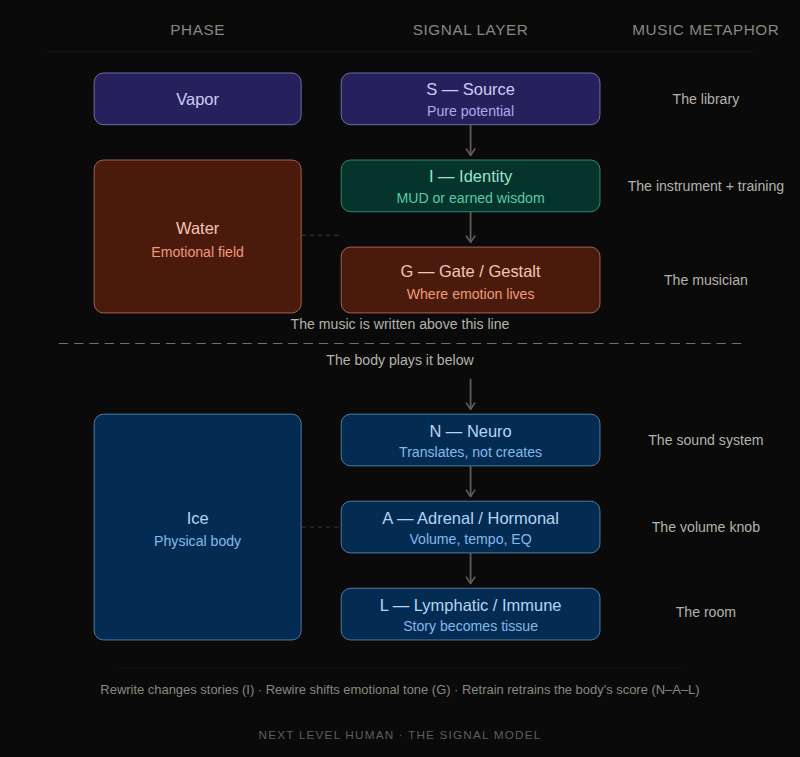
Source is the library. All possible music. Pure potential.
Identity is your instrument and your training. Essential nature gives you the tonal quality, the range, the timbre. Conditioning gives you the training: either MUD (one genre on autopilot, believed to be all there is) or earned wisdom (the full range, developed through metabolized experience).
The Gate is the musician’s habits. Their style. The reflexes, biases, and interpretive patterns that determine how incoming potential gets arranged. The Gestalt is the musical personality that emerges. When the Gate is narrow, everything sounds like a threat score. When the Gate clears, the music starts to sound like something real.
Emotions are the storms, specific reactions triggered by specific identity structures. Emotional tone is the climate.... the sustained atmosphere that shapes how every storm lands.
The nervous system is the sound system. It translates and performs whatever the Gate has composed. It never writes the music.
Hormones are the volume, tempo, and EQ. Cortisol keeps the volume pinned high. Thyroid sets the overall tempo. Sex hormones add warmth and drive. A system stuck on maximum volume cannot hear anything subtle.... which is why hormonal balance matters even though it’s downstream. But adjusting the volume doesn’t change the song.
The immune system is the room. The acoustics. The walls, ceiling, and floor that the music bounces off and reshapes over time. Years of threat-music warp the walls: chronic inflammation, suppressed immunity, accelerated aging. Years of coherent music keep the room resonant and open.
You can’t change the room by shouting at the walls. You change it by changing what plays in it, consistently, over time. This is where the story literally becomes tissue.
Three Tools for Three Levels
If this architecture is right, transformation requires three distinct tools, one for each level. Getting them in the right order matters. Confusing them with each other is the most common mistake in the field.
Rewrite works on stories. The specific MUD structures at the Identity level. You find the story. You trace it to its origin. You loosen the emotional charge fused to it (I call that charge the rebar, the structural reinforcement that makes the story feel true rather than merely believed) and open the possibility that the belief was a decision, not a fact. This is where memory reconsolidation happens. This is where individual storms lose their power.
Rewire works on emotional tone. The sustained climate at the Gate level. This is not about editing one story. This is about shifting the climate itself.... the personality set point, the chronic emotional atmosphere that the aggregate of all your identity structures produces. When the emotional tone shifts, the Gate widens. When the Gate widens, the whole style of music changes. Not just individual storms but the weather pattern underneath all of them.
Retrain works on how the body keeps the score. The nervous system, hormones, and immune function that have been performing the old music for years or decades. Breathwork. Movement. Nutrition. Sleep. Cold exposure. These retune the instruments and rebuild the room so the body can perform the new music consistently. Without Retrain, the body keeps defaulting to the old performance even after the composition has changed. But Retrain without Rewrite and Rewire is tuning a sound system that is still playing the same song.
Rewrite changes the stories. Rewire shifts the emotional tone. Retrain retrains how the body keeps the score.
That’s the order. Not because the other directions don’t matter.... intervention at any level sends ripples both ways. But because the composition always comes before the performance.
The Music Only You Can Play
There is one more thing this metaphor reveals. And it might be the most important thing in this entire piece.
Your conditioning was not a mistake.
The collisions, the wounds, the difficult training your instrument received before you were old enough to choose.... that was not something that went wrong. It was the curriculum. Without the specific collision between your essential nature and your specific conditioning, you could never develop the depth and nuance that make your music yours.
A musician who has never struggled plays technically. Cleanly. A musician who has struggled and metabolized that struggle plays with something else entirely. Something that cannot be taught. Something that can only be earned through the exact fire they went through.
This is why I use the term Essentia to describe the destination of this work, not the starting point. Essentia is not your essential nature alone. It is what emerges when three things come together:
Your essential nature (the instrument you were born as)
Your earned wisdom (the metabolized lessons of your specific suffering, the conditioning composted into range and depth)
Your free will (the purpose you choose to aim it all toward).
Essentia is not discovered like a treasure buried under the rubble. It is forged. Built from what you are, what you survived, and what you decide to do with both. That combination is unrepeatable. No other being in the history of consciousness has your instrument, your training, your collisions, your metabolizing, your integration, your choice.
The work.... all of it, from the first Rewrite to the last Retrain.... is about one thing: becoming a clear enough channel that the music Source intended for you, the piece only your exact life could produce, actually plays.
Not perfectly. Not without the occasional wrong note or the echo of an old arrangement creeping back in at 2am when you’re too tired to catch it.
But yours. Unmistakably yours.
The body doesn’t keep the score. It plays it.
And you are the one who gets to decide what’s written.
PS: If you're a coach, clinician, or practitioner who just read this and thought "this is what's been missing from my work".... the Human Architect Certification is where I train people to work with the full SIGNAL model. Rewrite. Rewire. Retrain. Not as concepts but as clinical tools. The next cohort is forming now. 👉 http://www.nextlevelhuman.com/human-coach
References:
Barrett, L. F. (2017). How emotions are made: The secret life of the brain. Houghton Mifflin Harcourt.
Barrett, L. F. (2017). The theory of constructed emotion: An active inference account of interoception and categorization. Social Cognitive and Affective Neuroscience, 12(1), 1–23. https://doi.org/10.1093/scan/nsw154
Chalmers, D. J. (1995). Facing up to the problem of consciousness. Journal of Consciousness Studies, 2(3), 200–219.
McCraty, R., & Childre, D. (2010). Coherence: Bridging personal, social, and global health. Alternative Therapies in Health and Medicine, 16(4), 10–24.
McCraty, R., Atkinson, M., Tomasino, D., & Bradley, R. T. (2009). The coherent heart: Heart–brain interactions, psychophysiological coherence, and the emergence of system-wide order. Integral Review, 5(2), 10–115.
McFadden, J. (2002). The conscious electromagnetic information (CEMI) field theory: The hard problem made easy? Journal of Consciousness Studies, 9(8), 45–60.
McFadden, J. (2013). The CEMI field theory: Gestalt information and the meaning of meaning. Journal of Consciousness Studies, 20(1–2), 175–198.
McFadden, J. (2020). Integrating information in the brain’s EM field: The cemi field theory of consciousness. Neuroscience of Consciousness, 2020(1), niaa016. https://doi.org/10.1093/nc/niaa016
This metaphor and the diagram really help to understand this new viewpoint which can be very nuanced!